
If one’s bullish on the price of gold over the next 6-12 months, one should be looking at high-quality junior miners, even early-stage ones.
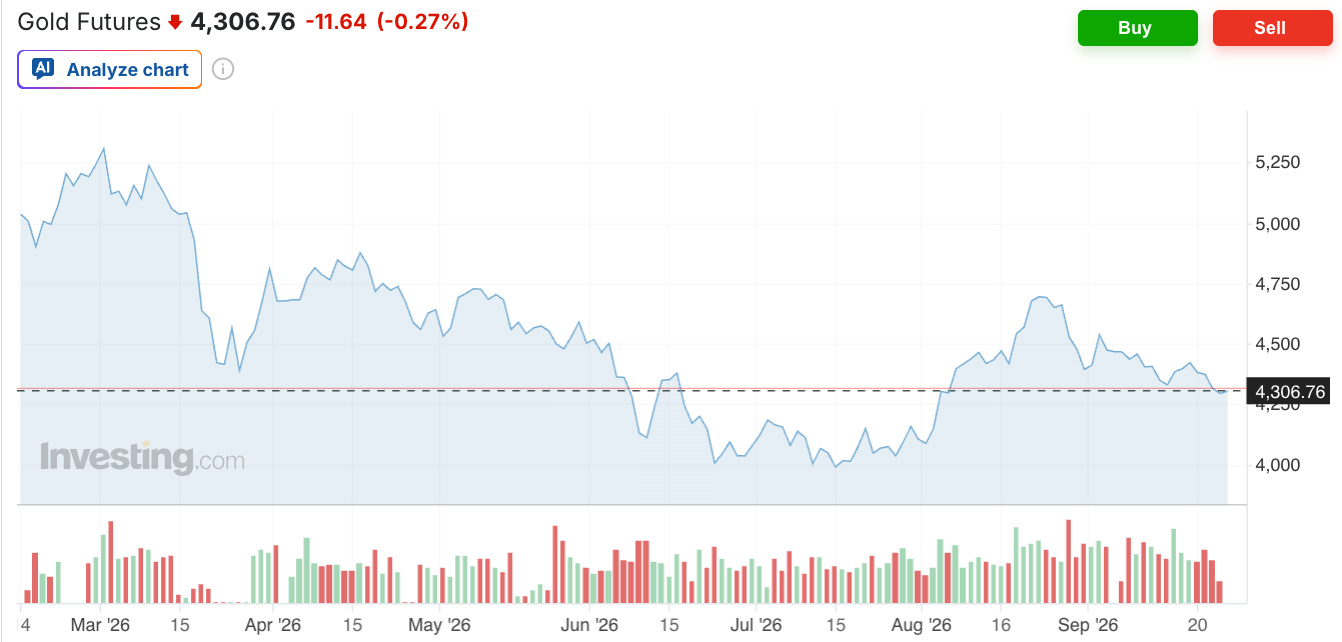
A rally in Au from today’s $4,300/oz to $5,000/oz (which would be ~$600 below the January peak) would deliver significant gains in junior miners. If one believes it’s a question of when, not if we retake $5,000, keep reading!
Admittedly, if it takes years to top $5,000 again, gains for juniors will be hard fought. Investment banks have recently updated year end views to US$4,500-$5,100. Goldman Sachs reaffirmed a $4,900 year-end target, citing ~50 tonnes/month of central-bank buying.
Wells Fargo trimmed its target range to $4,900–$5,100, while Citigroup lifted its 6–12-month outlook to $5,000. Although not base cases, JP Morgan and a few others have bull case scenarios of $5,500-$6,000.
On the downside, there appears to be meaningful support around $4,000, a price few dreamed possible 2-3 years ago (Au averaged $2,166/oz from 1/1/23 to 12/31/24)…
If Au is going to be $4,000-$6,000 through 12/31/27, I believe the top quartile of performers will be up many 100s of percent from here. What does a junior need to thrive?
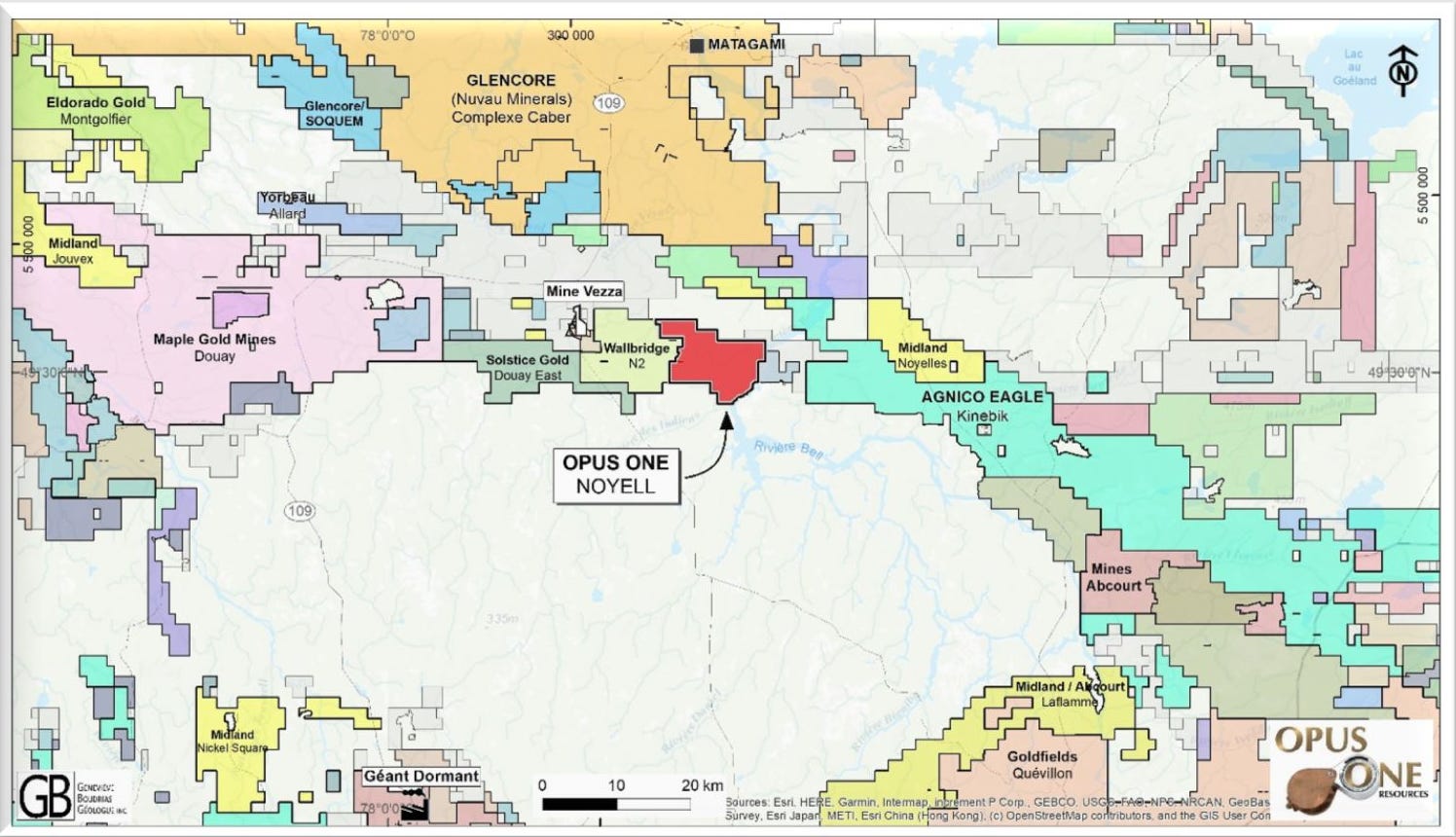
Mostly, a promising project, a strong team, a great jurisdiction, surrounded by other mines, projects, mills, power, roads, workforce, mining services, and the support of local communities/First Nations.
A company that checks a lot of investment boxes is Opus One Gold (TSX-v: OOR) / (OTC: GFKRF). Yes, it’s very high risk (like most juniors), is early-stage, and has a tiny enterprise value {market cap + debt - cash} of ~C$13M.
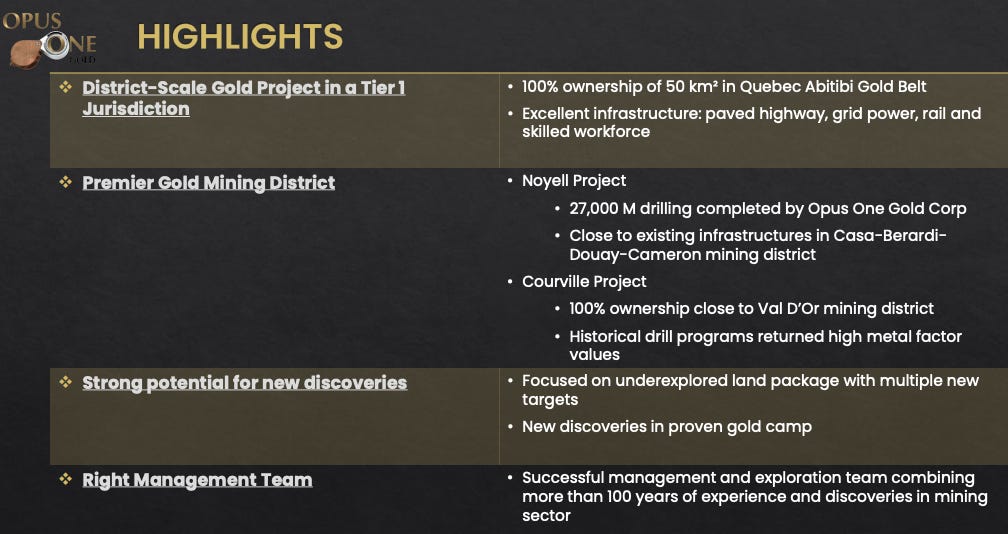
Yet, in a bull market there will be a tsunami of M&A driving valuations higher over time. Opus One’s flagship Noyell project occupies a strategic position on the Casa Berardi–Douay–Cameron corridor in the northern Abitibi Greenstone Belt, ~20 km south of Matagami, Quebec.
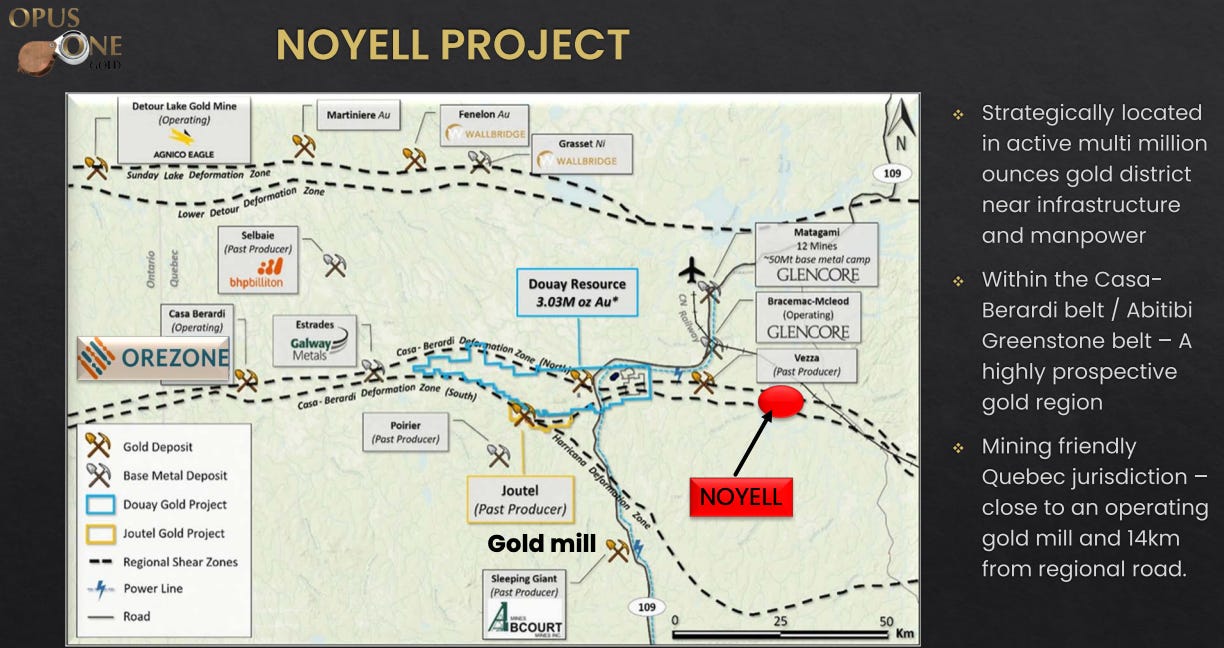
Opus owns 100% of its 4,482-hectare land package. Regional infrastructure is well established, highway 109 provides access, a road reaches to within ~14 km of the work area, there’s grid power, (low-cost, sustainable, hydroelectric), a workforce, mining services, a rail line to within 25 km, and a long-standing mining-friendly community.
Noyell’s location is attractive because substantial gold endowments have already been demonstrated along the same regional corridor. For instance, Orezone Gold’s Casa Berardi produced 91,160 ounces in 2025.
That mine is ~115 km away, not a likely mill site for Opus One unless Noyell can deliver a resource of 5+ g/t Au. Orezone acquired Casa Berardi from Hecla for up to C$800M (with earn outs), a true vote of confidence in northern Quebec.
Casa Berardi is a large shear-hosted mine. Noyell Zone 1 is smaller, but still wide open. It hosts quartz–carbonate–sulfide stock work in sediments. Noyell is more like a cousin than a twin to Casa Berardi.
The past-producing Vezza underground mine, ~9 km west of Noyell, is a better analog. It’s in the same Douay deformation corridor. Vezza was a small underground mine. It produced under a million ounces, but the grade was reportedly ~6 g/t Au. That size, rock package, and style are what Noyell could look like if Zone 1 holds together.
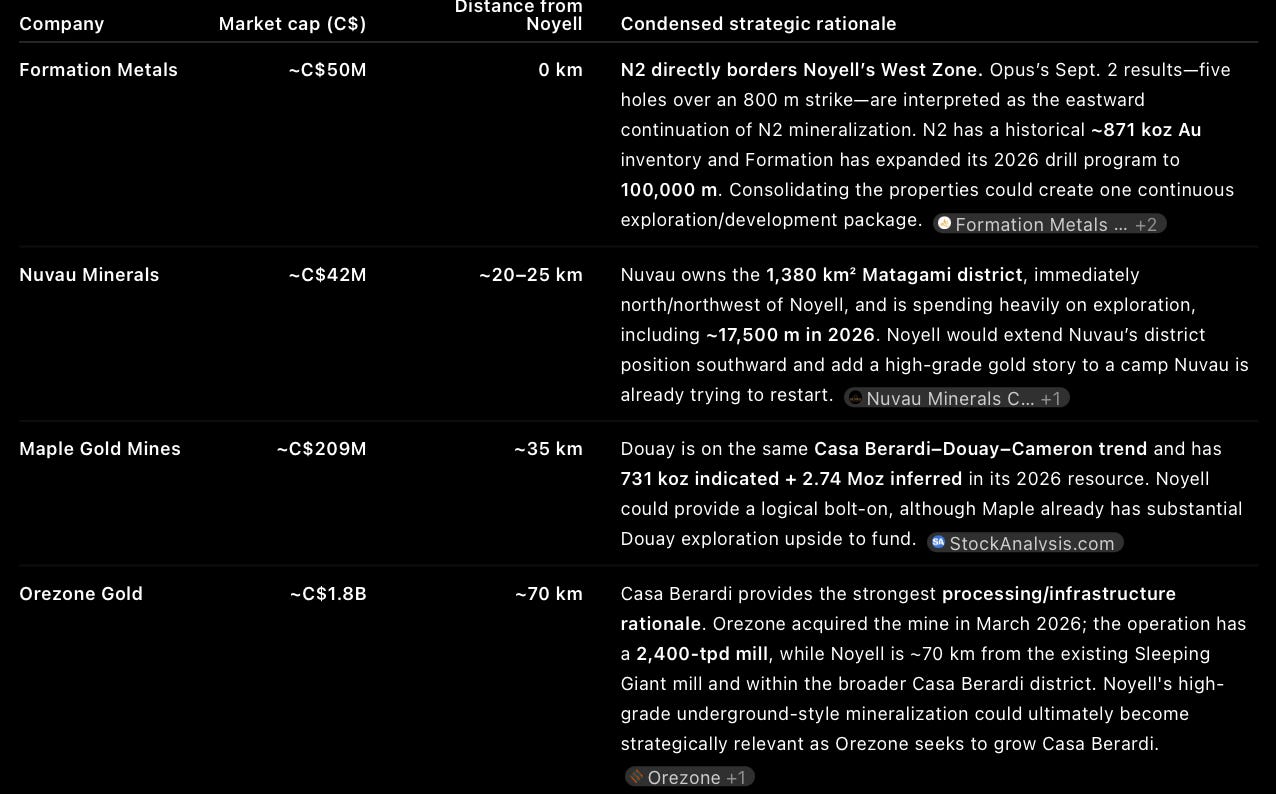
Maple Gold’s nearby Douay project has a newly updated resource of 731,000 ounces Indicated + 2.74M Inferred. Directly adjoining Noyell, Formation Metals’ N2 project has an historical inventory of 871,000 ounces, and is undergoing a major, fully-funded, 75,000 meter drill program right next door to Opus One.
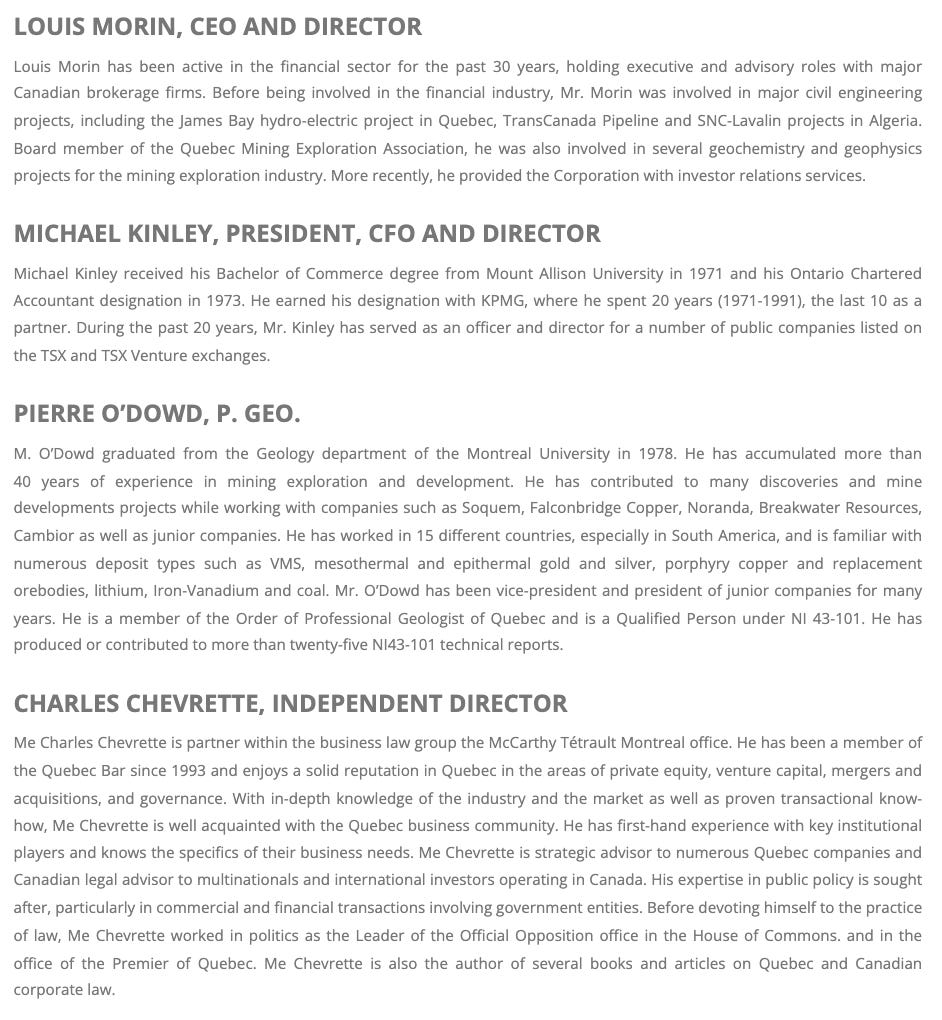
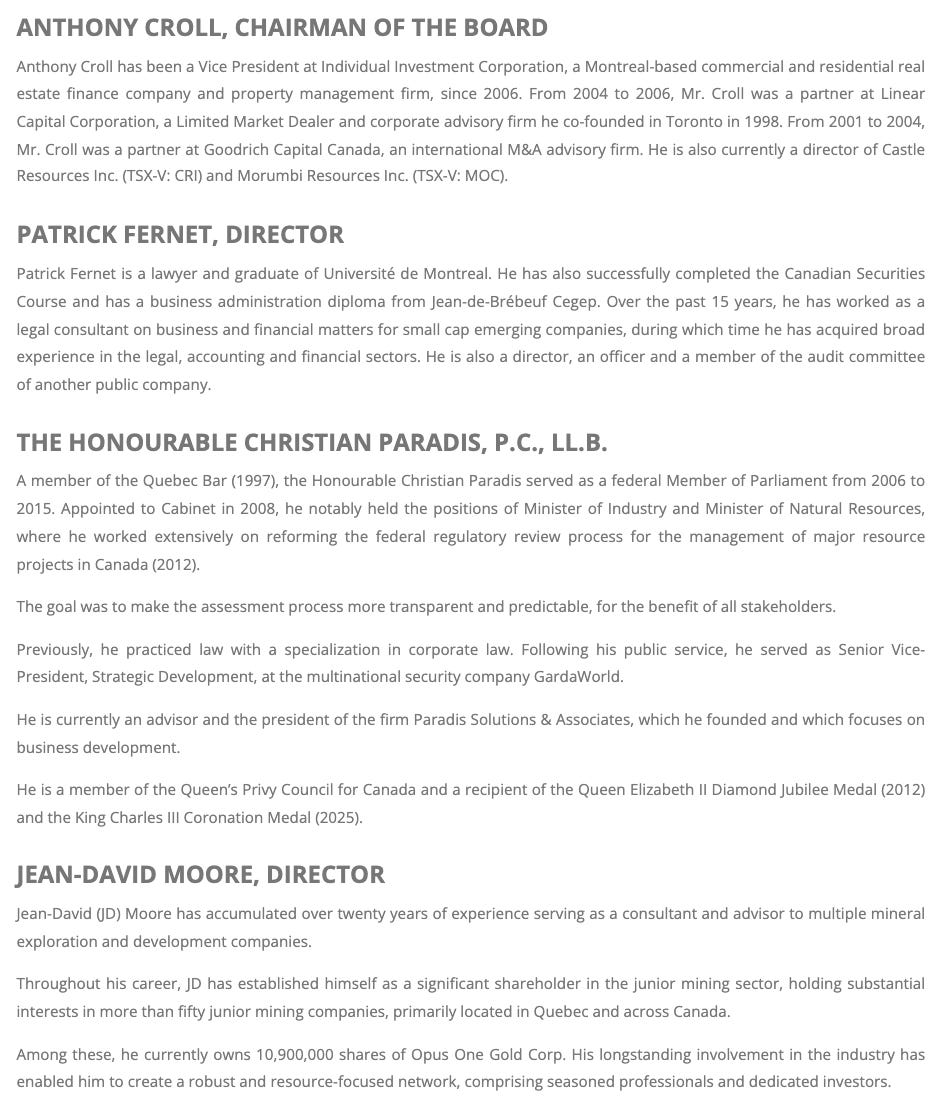
Nuvau Minerals is actively exploring the former Glencore Matagami ground. Noyell is surrounded by companies committing significant exploration and development capital. Readers are urged to review the executive bios (above/below).
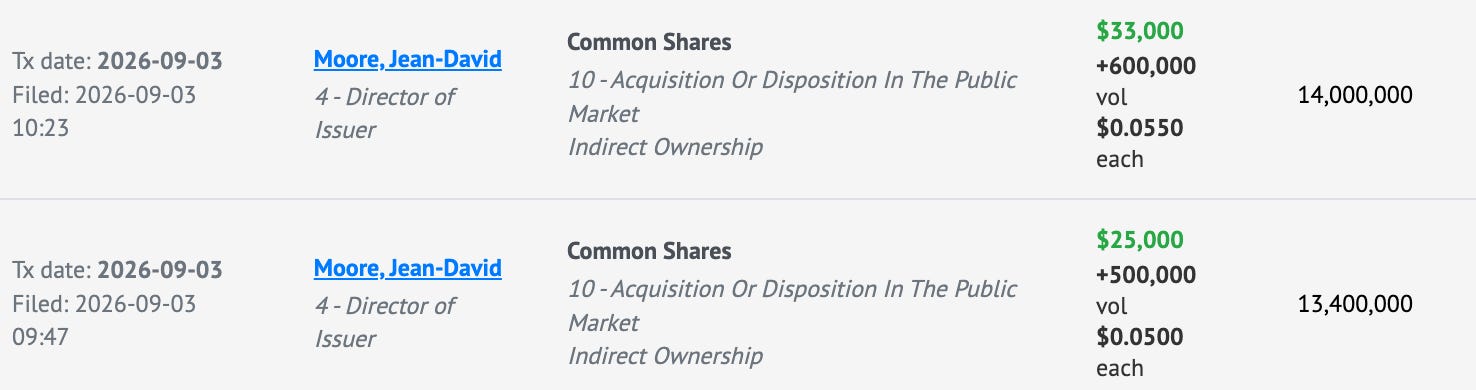
In addition to long-term CEO Louis Morin, please see the other impressive execs involved, including Jean-David Moore who’s been an active acquirer of shares in the open market!
He now owns 14,000,000 shares, having just purchased 1.1M shares the same day this article was written (Sept. 3rd).
Zone 1 is a key reason Noyell has become a compelling exploration story. Drilling has demonstrated mineralization from near surface to ~700 m vertical depth, with the deepest hole returning ~11.4 m at 4.9 g/t Au, (~9.1 m true width).
That intercept sits 200 m below another hole which returned 8.5 m at 8.2 g/t Au, incl. 1.3 m at 49.1 g/t Au. Earlier drilling produced intervals such as; [18.95 m at 4.2 g/t], and [5.2 m at 8.96 g/t].
Zone 1 is promising, a combination of grade, width and vertical continuity over hundreds of meters. Add to Zone 1 the West Zone, a separate layer of exploration upside. At West Zone, five initial shallow holes totaling 1,467 m tested a previously un-drilled area.
All five intersected the principal target across an 800 m strike length. Results included [8.3 m at ~1.3 g/t Au], [9.1 m at ~1.2 g/t], and [1.2 m at ~3.5 g/t]. The Company interprets the mineralization as potentially representing continuity from an unnamed neighboring property to the west (I believe that’s Formation Metals).
Although lower grade than Zone 1, these results are significant as they suggest Noyell’s potential is not confined to known Zone 1 mineralization. And, importantly, the exploration footprint extends beyond Zone 1 and the West Zone, there are Zone 2 and other geochemical targets.
Zone 2 is intersected in some (not all) drill holes, 10s of meters from Zone 1. It’s lower grade, but stacked mineralized zones can be attractive if not too far apart and if the grade is not too low.
Opus One has drilled 12,000 m in 2026, following ~9,000 m in 2025, materially increasing the amount of geological information available across the property. Early metallurgical work provides another encouraging data point.
A 2026 LIBS study of Zone 1 core from both shallow & deep holes identified Au occurring in free form, finely disseminated, associated principally with sulfides including pyrrhotite, pyrite & arsenopyrite.
Free gold sitting within those sulfides is considered good for milling. Au is not trapped inside a hard mineral, so a standard grind & cyanide leach can free it. Abitibi mills routinely treat pyrite & arsenopyrite. Early indications (subject to more work) are that this rock should not be difficult to process.
Noyell offers a favorable combination for a gold junior --> 100% ownership of a sizable land package, established infrastructure, a high-grade Zone 1 system demonstrated from near surface to at least 700 m vertical depth, and a newly confirmed 800 m West Zone, (lower grade, but 5 of 5 initial holes hit mineralization).
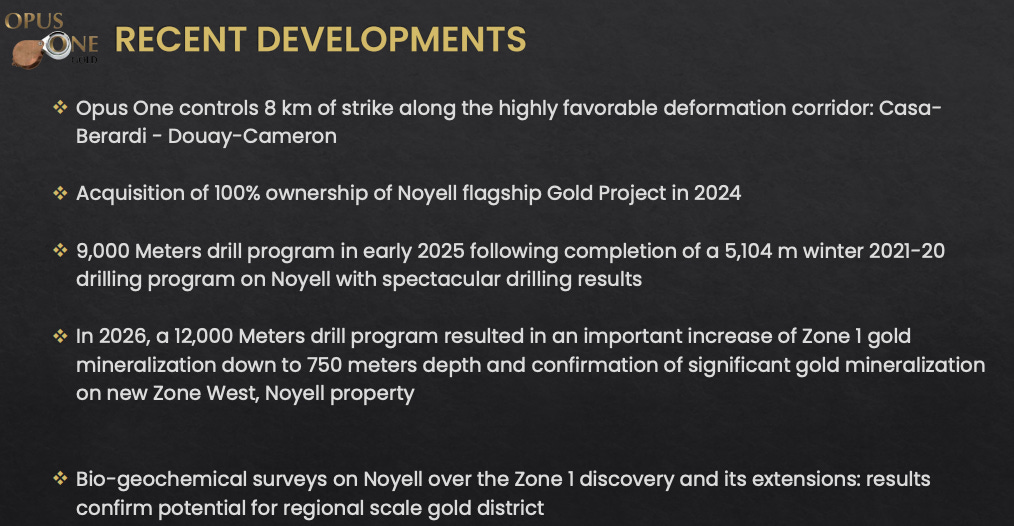
In addition, there are multiple targets at Zone 1, the West Zone, and in other un-drilled areas. In my opinion, exploration to date should lead to a maiden resource estimate in 1H/27.
If the Company could book 500,000+ ounces in a first pass, surrounded by several other attractive resources, projects, mines, mills, and past producers, Noyell could attract the attention of larger players.
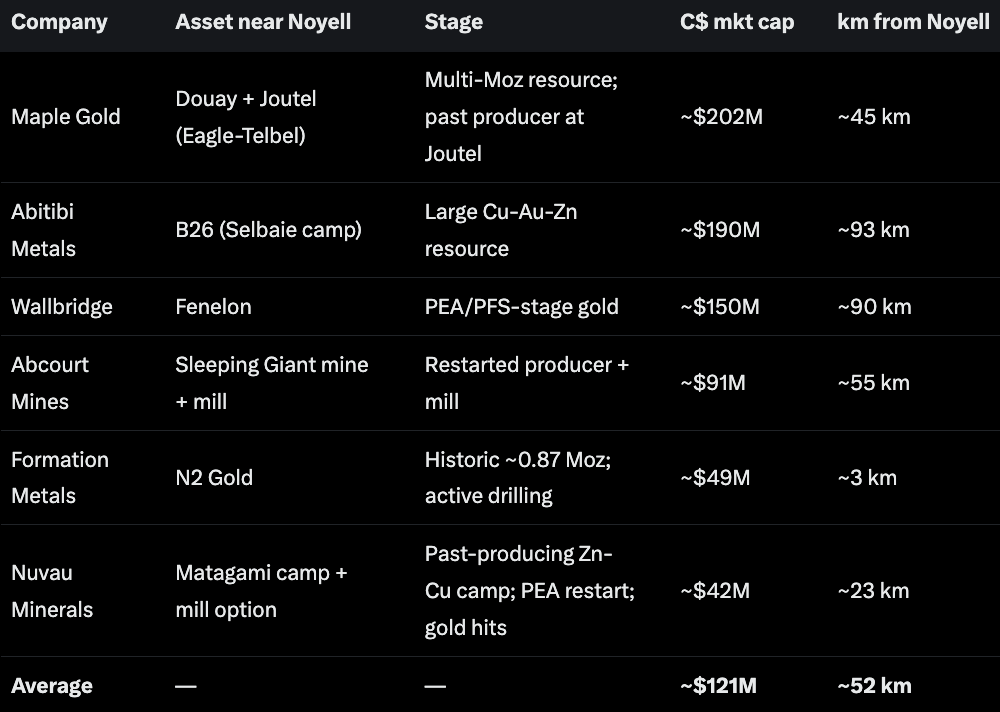
There are other juniors in the area, but most have meaningfully larger valuations. The average distance of the following companies’ flagship projects is ~52 km, and the average market cap ~C$121M.
By contrast, Opus One is valued at ~C$13M (C$0.05/shr.). Success at any of these peers could boost the investment rationale for Opus One.
THESE PROJECTS NEAR OPUS ONE’S NOYELL…
Bottom line: Opus One is in the right place, at the right time, with the right team, searching for one of the best commodities on earth. Very high risk, but commensurately high return potential.
This is a company advancing what **could be** a large Au system in one of Canada’s more exciting mining jurisdictions.
In a bull market, it sometimes makes sense to take on elevated investment risks. One should probably not bet the farm on Opus One Gold (or other tiny junior miner!), but the next few years could be quite rewarding for juniors who advance promising projects in safe, prolific jurisdictions.
Disclosures/disclaimers: The content of this article is for information only. Readers fully understand and agree that nothing contained herein, written by Peter Epstein of Epstein Research [ER], (together, [ER]) about Opus One Gold, including but not limited to, commentary, opinions, views, assumptions, reported facts, calculations, etc. is not to be considered implicit or explicit investment advice. Nothing contained herein is a recommendation or solicitation to buy or sell any security. [ER] is not responsible under any circumstances for investment actions taken by the reader. [ER] has never been, and is not currently, a registered or licensed financial advisor or broker/dealer, investment advisor, stockbroker, trader, money manager, compliance or legal officer, and does not perform market-making activities. [ER] is not directly employed by any company, group, organization, party, or person. The shares of Opus One Gold are highly speculative, and not suitable for all investors. Readers understand and agree that investments in small-cap stocks can result in a 100% loss of invested funds. It is assumed and agreed upon by readers that they will consult with their own licensed or registered financial advisors before making investment decisions.
At the time this article was posted, Opus One Gold was an advertiser on [ER] and Peter Epstein owned no shares in the company.
Readers understand and agree that they must conduct due diligence above and beyond reading this article. While the author believes he’s diligent in screening out companies that, for any reason whatsoever, are unattractive investment opportunities, he cannot guarantee that his efforts will (or have been) successful. [ER] is not responsible for any perceived, or actual, errors including, but not limited to, commentary, opinions, views, assumptions, reported facts & financial calculations, or for the completeness of this article or future content. [ER] is not expected or required to subsequently follow or cover events & news, or write about any particular company or topic. [ER] is not an expert in any company, industry sector or investment topic.